Why your kitchen sponge smells, and the only fix that works
It is not dirt and it is not the brand. A wet sponge is a habitat. The fix is drying, and most kitchens make drying impossible.
illegalsoup3 min read
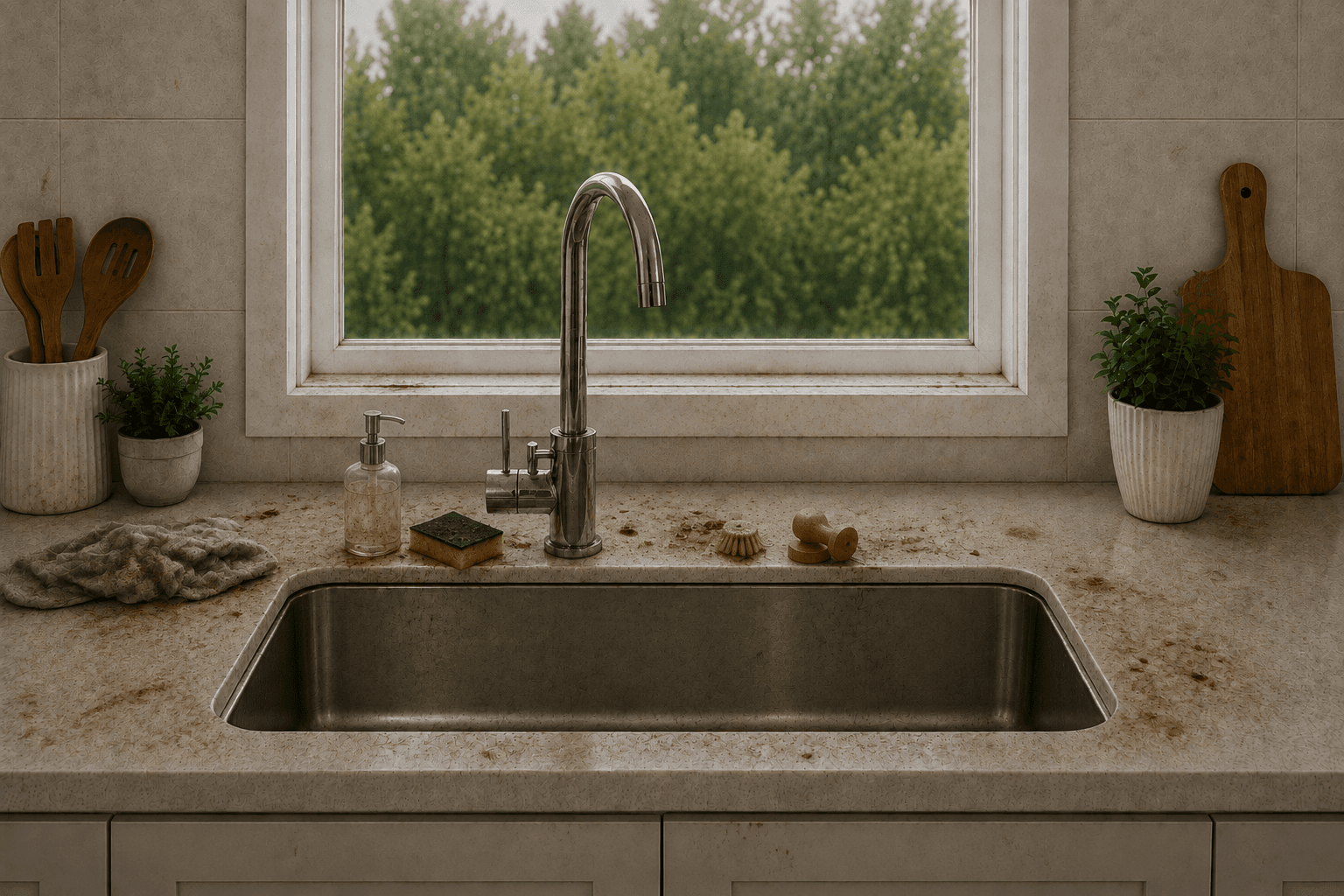
You rinse it thoroughly. You squeeze it out. By the next evening it smells sour again, and running it under hot water buys you about an hour.
The sponge is not dirty in the way you are treating it. It is wet, and it has been wet continuously for days.
The actual mechanism
A kitchen sponge is close to a perfect growth environment. Enormous internal surface area, moisture held in that structure for a long time, food residue trapped in the pores, and room temperature throughout.
Bacteria on a surface that dries between uses cannot do much. Bacteria in a sponge that never fully dries have warmth, moisture and food continuously available. The sour smell is the by-product.
Which leads to the only conclusion that matters: the variable you control is how fast it dries. Not how hard you rinse it, and not which brand you buy.
Why the usual storage spots guarantee it stays wet
Look at where the sponge actually lives in most kitchens.
Flat on the counter. Only the top face meets air. The underside sits in its own puddle, and the counter stays damp too. That is the wet patch beside the tap that never seems to dry.
In the sink. Worse, because it gets splashed every time the tap runs. It is being re-wetted continuously.
In a solid-bottomed caddy. Looks tidy, functions as a small bowl. Water drains out of the sponge, collects in the base, and the sponge sits in it.
Wedged behind the tap. Poor airflow, plus a permanently damp patch on whatever it touches.
All four share one failure: water has nowhere to go, and air cannot reach most of the sponge.
What actually works
Two conditions, and you need both.
1. Water must be able to leave. The sponge sits on something open rather than in something solid. Wire, mesh, slots, anything that lets water fall away instead of pooling.
2. Air must reach most of the surface. Suspended in open air dries far faster than lying against a solid surface, because you have exposed most of the sponge rather than one face.
Get both and a sponge that used to stay damp for days is dry in hours. That single change does more than anything else you can do to it.
The practical version
Wring it out properly. Not a light squeeze. Fold and press hard, then open it back out so the structure is not left compressed.
Put it somewhere open and off the surface. Over the sink is ideal, because the water draining out goes where water is supposed to go rather than onto your counter.
Give the dish brush the same treatment. Bristles-down in a cup is the same trap, with water collecting in the base.
Replace it on a schedule, not on appearance. Sponges degrade with use. One that smells again immediately after drying properly has reached the end of its life. Drying well extends that; it does not make it permanent.
Do not bother microwaving it. Popular tip, inconsistent results, damages sponges containing synthetic or metallic material, and it is a genuine fire risk. Drying between uses achieves more with none of the downside.
Why this is annoying to solve in a rented kitchen
The obvious fix is a rack over the sink. The obvious rack needs drilling, and if you are renting, drilling into tile is either not allowed or not worth the argument over your deposit.
Adhesive holders are the usual alternative, and they have a predictable failure mode. The one part of the kitchen that is permanently wet is exactly where the adhesive has to hold. They let go after a few weeks, usually into the sink.
What works in a rented kitchen is something that clamps onto the tap itself. No holes, nothing stuck to a wet wall, and it lifts off cleanly when you move out.