Why your tank water turns muddy after it rains
Three different problems look identical in a bucket. Here is how to tell silt from disturbed sediment from rust, and what actually fixes each one.
illegalsoup4 min read
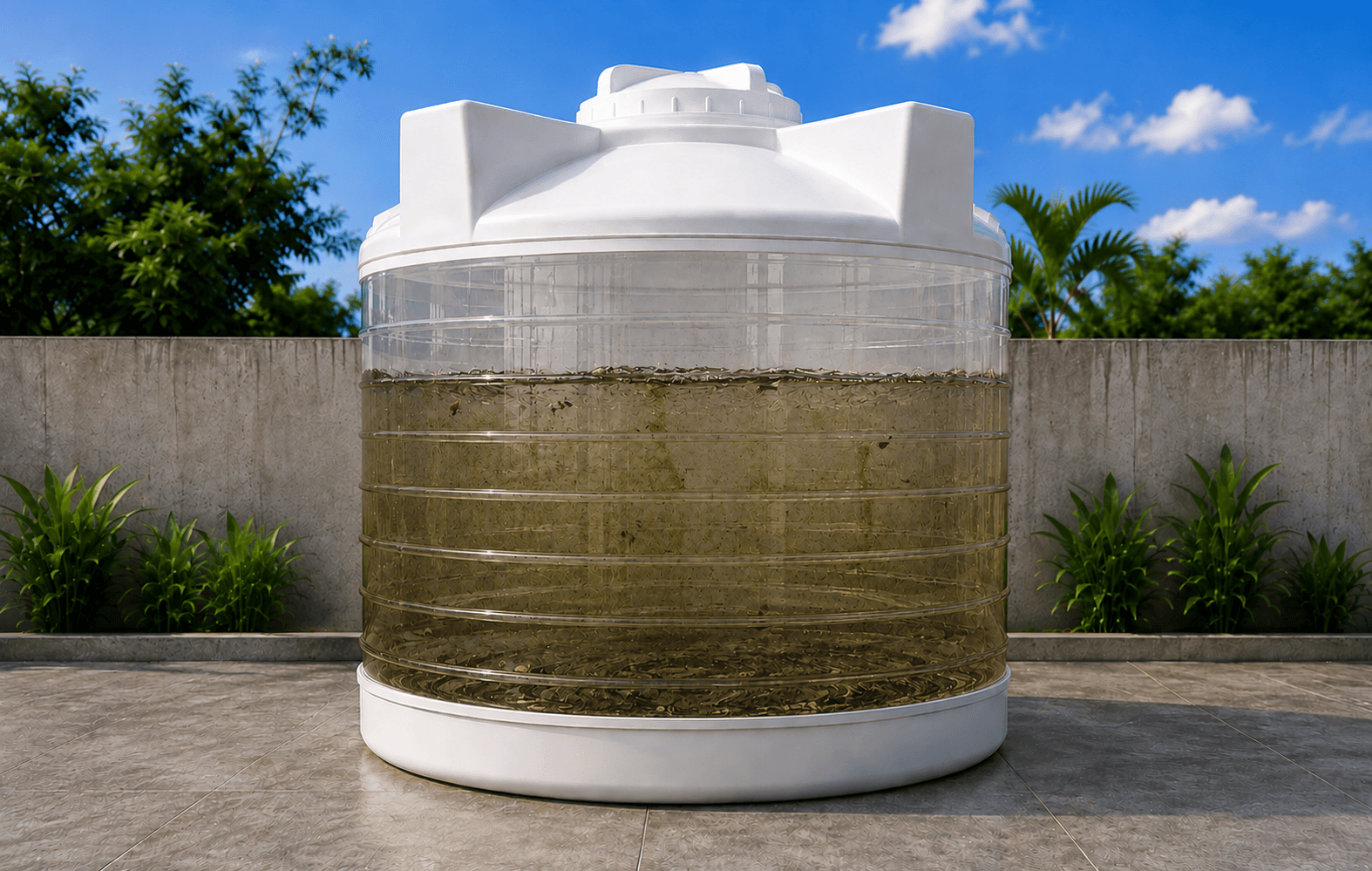
The water was fine on Tuesday. It rained on Wednesday night. On Thursday morning the bucket has a brown tint, and by the time you have finished bathing there is a thin gritty film at the bottom.
This is one of the most common water complaints in Indian homes, and it is also one of the most commonly misdiagnosed. Three completely different problems produce almost identical looking water. Fixing the wrong one wastes money and changes nothing.
The three things that make tank water dirty
1. Silt arriving with the supply
Rain moves soil. Surface runoff carries fine clay and silt into open wells, into shallow borewells, and into municipal lines wherever there is a break or a pressure drop. That material travels down the pipe and into your tank.
The tell: it appears within a day or two of heavy rain, and it affects every tap in the house at once.
2. Sediment that was already in your tank
This is the one people miss. Your tank has been quietly collecting sand, grit and fine particles for months. It sits in a settled layer at the bottom and you never see it, because water is drawn from above that layer.
Then something stirs it up. A tanker refill that dumps water in hard, a sudden pressure surge, or the tank running low enough that the outlet starts pulling from near the floor.
The tell: it appears suddenly without rain, often right after a refill, and it clears up after a day or two of normal use, then comes back.
3. Rust from the pipes
Older galvanised iron plumbing corrodes from the inside. Flakes break loose, especially after the line has been sitting still or after a pressure change.
The tell: the colour leans orange or reddish rather than brown or grey, it is often worse first thing in the morning after the pipes have been idle overnight, and it may affect some taps more than others depending on which runs are oldest.
How to work out which one you have
You do not need a test kit. You need a clear glass and ten minutes.
Fill a clear glass from the tap and leave it undisturbed on a flat surface.
- Particles settle to the bottom within a few minutes, water above turns clear. This is suspended solids, so silt, sand or grit. Cases 1 or 2.
- The colour stays evenly distributed with nothing settling. This is dissolved, not suspended. Sediment filtration will not help you. Get the water tested.
- Settled particles are orange or rust coloured and slightly heavier. Case 3, corrosion from your plumbing.
Then check the timing. Rain-linked means supply. Refill-linked means your own tank. Morning-only means your pipes.
What actually fixes each one
Silt from the supply is stopped at the inlet. You need something physically in the path of the incoming water that catches particles before they reach the tank. This is what a sediment filter does, and it is the only one of the three that a filter genuinely solves at the source.
Sediment already in your tank needs the tank cleaned out. No filter fixes this, because the material is already past the filter and sitting on the floor of your tank. Clean it, then filter the inlet so the layer stops rebuilding.
Rust from pipes is a plumbing problem. A sediment filter at the tank inlet sits upstream of your household pipes, so it cannot catch rust that forms downstream of it. Replacing the worst runs is the real fix. A point-of-use filter at a specific tap can help in the meantime.
What does not fix it
Boiling. It kills organisms. It does nothing to sand, and it slightly concentrates dissolved solids as water evaporates.
An RO unit alone. RO is built to remove dissolved solids, not to strain out grit. Feed muddy water into an RO system and you will foul the membrane fast. RO systems are supposed to sit behind sediment pre-filtration, not replace it. There is more on this in sediment filter vs RO.
Letting it settle in the tank. It does settle, which is exactly how you build the layer described in case 2. You have not removed anything, you have stored it.
The order to do things in
If you have silt arriving with your supply, doing these out of order wastes effort:
- Clean the tank first. Filtering the inlet while a sediment layer sits on the floor means you still get cloudy water every time it is disturbed.
- Then filter the inlet, so the layer stops rebuilding.
- Then set a cleaning rhythm, because no filter catches everything.
There is a step by step for the first two in how to get sand and silt out of an overhead water tank.
One honest caveat
A sediment filter is a physical strainer. It is very good at sand, silt, mud and rust particles. It does nothing about bacteria, hardness, dissolved iron, or anything you cannot see. If your water is discoloured but nothing settles out in the glass test, filtration is the wrong tool and you should get the water tested before spending anything.